
Health Insurance in the Villages Around Godhra: A Step-by-Step Buying Guide
For families in the villages of Godhra taluka, buying health insurance is mostly paperwork and a few decisions. This guide walks through them in order, from the first question to the policy document.

Dharmendrasinh Raulji
Chairman, Raulji Group
Published
10 min read
Quick answer
How can a family in a village near Godhra buy health insurance? Decide who needs cover and roughly how much, list the hospitals you would actually use in Godhra and Vadodara, then compare policies on waiting periods, room rent limits, co-payment and network hospitals. Buying itself is mostly paperwork: a proposal form with honest medical answers, identity and address documents for KYC, and payment. When the policy arrives, you have 30 days to read it and return it if it is not what you expected.
- None of this requires an office visit. Proposal, documents and payment can be completed remotely.
- The proposal form's medical questions matter more than anything else you fill in.
- Under the IRDAI rules, the free look period is 30 days from receiving the policy document.
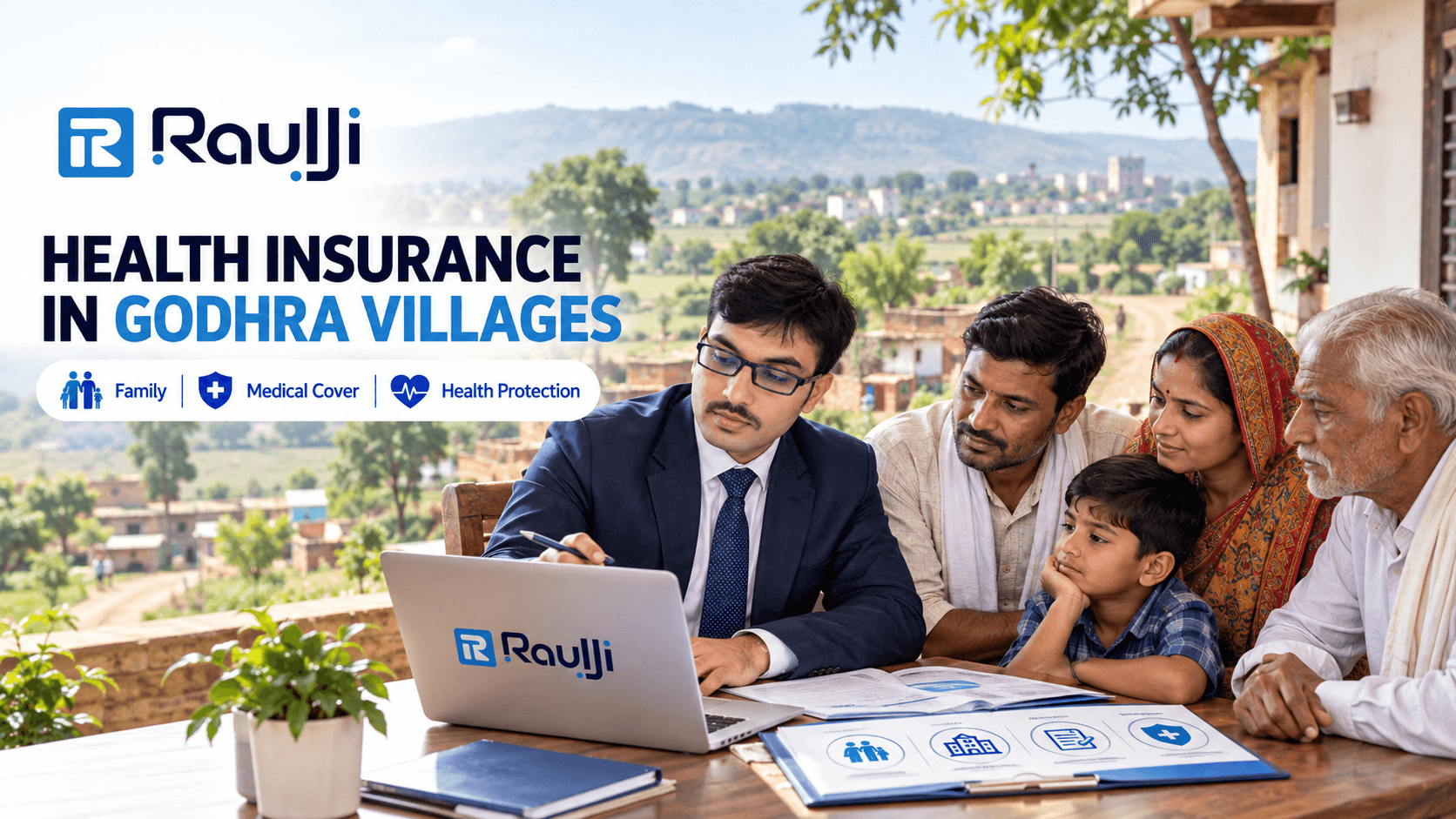
- Raulji Group is based in Vadodara and has no office in these villages. Families can discuss their requirement with Dharmendrasinh Raulji by WhatsApp or phone.
Godhra taluka in Panchmahal district takes in the town of Godhra and many villages around it, among them Kakanpur, Tuwa, Moti Kantadi, Nani Kantadi, Ratanpur (Kantdi), Timba, Kabirpur, Lilesara and Pandva. For families in these villages, the town is usually where hospital treatment starts, and Vadodara is where many go for specialist care.
This guide is for those families. Rather than repeating how policies work, which the Godhra health insurance guide covers for the whole area, it explains the part people find least clear: how to actually buy a policy, step by step, without travelling to an office. It does not recommend any insurer or product.
What to decide before comparing policies
Three decisions come before any comparison: who in the family needs cover, whether they should share one sum insured or have their own, and roughly how much cover one serious hospital admission would need at the hospitals you would use.
- Who needs cover. Note each person's age and any condition they have been diagnosed with or take regular medicine for. Both shape the premium and the waiting periods.
- Shared or separate. A family floater shares one sum insured. Older parents are often better on a policy of their own, so a claim for them does not use up the family's cover.
- How much. Think about the hospital you would actually go to for a serious admission, in Godhra or in Vadodara, and what treatment there might cost.
With those three answers, policies can be compared properly. The Panchmahal guide to comparing health insurance sets out the order to compare them in.
How do you buy a health insurance policy, step by step?
Buying a health policy means completing a proposal form, providing documents for identity verification, answering the medical questions accurately, paying the premium and receiving the policy document. Some insurers also ask for a medical check-up, usually for older applicants or larger sums insured.
- 1
Choose the policy and sum insured
Shortlist using the waiting periods, room rent limit, co-payment and network hospitals, not the premium alone.
- 2
Complete the proposal form
The proposal form records who is to be covered and their medical history. Answer every medical question accurately for every person, including conditions that are under control with medicine.
- 3
Provide KYC documents
Insurers verify the identity and address of the proposer before issuing a policy. Keep identity and address documents, a photograph and age proof ready for each person.
- 4
Medical check-up, if asked
Depending on age, health history and sum insured, the insurer may ask for tests before deciding. Its decision may be to accept, to accept with conditions such as a specific waiting period, or to decline.
- 5
Pay the premium
Pay through a traceable method and keep the receipt. Cover starts on the date stated in the policy, not the date of payment.
- 6
Receive and check the policy document
Check every name, date of birth, the sum insured and the start date. Errors are far easier to correct now than at claim time.
The free look period: 30 days to change your mind
The free look period is a window after you receive the policy document during which you can review the terms and return the policy if it does not suit you. Under the current IRDAI rules it is 30 days from receipt of the policy document. The refund is adjusted as the rules allow, for example for any medical tests done and the days of cover provided.
Use the free look period to read the Customer Information Sheet that comes with the policy. It is a short, standard summary of the sum insured, waiting periods, exclusions, co-payment, sub-limits and claim procedure. If a term in it surprises you, this is the time to ask, while returning the policy is still simple.
Check within the 30 days
- Every insured person's name and date of birth
- The sum insured, and whether it is shared or individual
- The waiting period for every condition you declared
- Any room rent limit, co-payment or sub-limit
- That the hospitals you would use are in the insurer's network
Keeping the paperwork for a claim later
A family in a village is more likely than one in town to be admitted in an emergency at whichever hospital is nearest, which may not be in the insurer's network. That makes reimbursement claims more likely, and a reimbursement claim depends entirely on paperwork.
- Keep the policy document, the Customer Information Sheet and the premium receipt together, with a copy on a family member's phone.
- Save the insurer's claim helpline number with the policy number.
- Note the time limit for reporting an emergency admission.
- Note the renewal date. Waiting period credit is built only while the policy is renewed without a break.
How waiting periods run and how claims are settled is explained step by step in the Kalol health insurance claims guide.
Mistakes families make when buying a policy
- Signing a proposal form filled in by someone else without reading it. The medical answers are yours, whoever wrote them down.
- Choosing on premium alone. A cheaper policy with a room rent limit and co-payment can pay much less on the same admission.
- Not checking the network for Godhra hospitals. A large network elsewhere does not help if the hospitals you would reach first are not on it.
- Putting grandparents on the family floater by default. Their likely claims draw down the cover the children rely on.
- Paying in cash without a receipt. Pay through a traceable method and keep the receipt with the policy.
- Missing the first renewal. A lapse in the first years loses the waiting period credit the family has started to build, and a new policy starts the clock again.
Every one of these is avoidable before the policy is bought, and most of them are much harder to fix afterwards.
Health insurance in the villages of Godhra taluka
The policy terms are the same in every village. What differs is mainly which hospitals a family would reach first and who in the household needs cover. Some villages have their own guide, each focused on one topic.
Kakanpur
The Kakanpur health insurance guide is about one decision that most households face: whether to cover the family on one floater or give members individual policies, worked through for different kinds of household.
Tuwa
The Tuwa health insurance guide explains what a policy actually pays for, and what it usually does not, so a family knows what to expect before a hospital stay.
Moti Kantadi, Nani Kantadi and Ratanpur (Kantdi)
The Kantadi villages, also written Katdi, have a guide on health insurance for parents and senior citizens, covering age limits, co-payment, pre-existing conditions and government schemes for older people.
Timba, Kabirpur, Lilesara and Pandva
Families in Timba, Kabirpur, Lilesara and Pandva (also spelt Pandwa) will find that everything in this guide applies directly. For most families here, the first thing to check is which hospitals in Godhra town are in the insurer's cashless network. For the family-level questions, the Kakanpur, Tuwa and Kantadi guides apply just as well.
Getting help without travelling
Raulji Group is based in Vadodara and has no office in Godhra taluka. Families in these villages can discuss a health insurance requirement with Dharmendrasinh Raulji by WhatsApp or phone, and documents can be shared digitally. Raulji Group helps people understand and arrange cover; it does not underwrite insurance, and claim decisions rest with the insurer. More is on the insurance services page, and every policy term is explained in the health insurance guide for India.
Sources
- IRDAI (Insurance Products) Regulations, 2024The 30-day free look period and the maximum pre-existing disease waiting period of 36 months.
- IRDAI Master Circular on Health Insurance Business, 29 May 2024The Customer Information Sheet and policyholder entitlements.
Written by
Dharmendrasinh Raulji
Dharmendrasinh Raulji is Chairman of Raulji Group and handles its insurance advisory enquiries directly.
This article is for general information only and is not insurance advice or a recommendation of any insurer or product. Documents, medical underwriting and policy terms vary between insurers and products. Read the Customer Information Sheet and policy wording, and confirm current terms with the insurer before deciding. Raulji Group does not underwrite insurance; claim decisions rest with the insurer.