
What this article covers
- Which parts of business registration are national and which are genuinely state-level
- How the four structures apply to the kinds of business Gujarat actually runs
- The Gujarat registrations that follow incorporation, including the 30-day Shops and Establishments deadline
- Where stamp duty and the Registrar of Firms make the state matter
The short answer
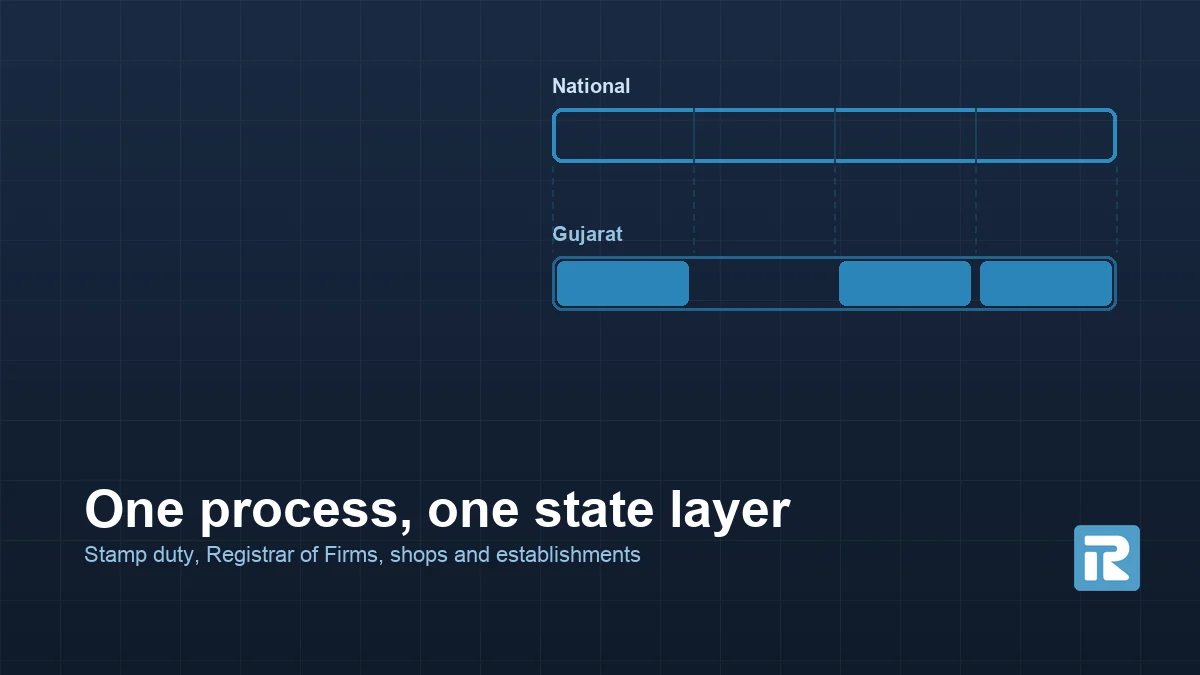
Company and LLP incorporation is a central process handled through the Ministry of Corporate Affairs, so it is the same from anywhere in Gujarat. What is specific to the state is the layer around it: stamp duty on deeds and agreements, partnership registration with the Gujarat Registrar of Firms, professional tax, and registration under the Gujarat Shops and Establishments Act, 2019.
- Companies registered in Gujarat fall under the Registrar of Companies at Ahmedabad, but filing is online and the office you fall under does not change the process.
- Every establishment in Gujarat is required to register or give intimation under the Shops and Establishments Act, 2019 within 30 days of commencing operations.
- The structure decision is the same one entrepreneurs face anywhere. Being in Gujarat does not make a particular structure the right one.
A lot of writing about starting a business in Gujarat is the same national article with the state's name inserted at intervals. That is not useful, because it obscures the thing worth knowing: most of what happens during registration is national, and the parts that are genuinely local are specific enough to matter.
This guide separates the two. First the structures, which are the same decision anywhere in India. Then the Gujarat layer, which is where being in Rajkot rather than Raipur actually changes something.
What is the same everywhere in India?
Incorporation of a Private Limited Company or an LLP is a central process, filed on the Ministry of Corporate Affairs portal. The forms, documents, name approval rules and annual filings do not vary by state.
Companies and LLPs with a registered office in Gujarat fall under the jurisdiction of the Registrar of Companies at Ahmedabad, which also covers Dadra and Nagar Haveli. In practice this is an administrative fact rather than a procedural one. The filing is made online, the certificate is issued electronically, and a founder in Bhuj goes through the same steps as one in Ahmedabad.
The same is true of the things that follow: PAN and TAN, GST registration, Udyam registration for micro, small and medium enterprises, EPFO and ESIC. All are national systems.
The four structures, and how they apply here
Gujarat's business base is heavily weighted towards family-run manufacturing and trading. Ceramics around Morbi, textiles and diamonds in Surat, chemicals and engineering across the Vadodara, Bharuch and Ankleshwar belt, brass around Jamnagar, engineering and castings in Rajkot, and a broad base of trading and services in Ahmedabad. A lot of these businesses have been running for two or three generations, often as partnership firms or proprietorships, and the structure question usually arrives with a specific trigger: a generational handover, a bank asking for something, a large buyer asking for something else, or a family member wanting out.
| Structure | Liability | Typically considered when |
|---|---|---|
| Proprietorship | Unlimited | A single owner starting a shop, a small trading business or a professional practice, and wanting to begin quickly with minimum administration. |
| Partnership Firm | Unlimited, joint and several | Two or more people, often family, running a business on agreed terms. Common in established trading and manufacturing businesses in the state. |
| LLP | Limited to agreed contribution | Partner-run businesses that want the liability line and continuity without a company's compliance. A frequent destination when a long-standing family firm restructures. |
| Private Limited Company | Limited to unpaid amount on shares | Businesses raising equity, planning a generational transfer through shareholding, or dealing with buyers and lenders who expect a company. |
It is worth saying plainly: there is no Gujarat answer to the structure question. The considerations are liability, the number of owners, compliance capacity and funding plans, and they work the same way here as anywhere. A structure that suits a Morbi tile manufacturer with heavy credit exposure to distributors is not the structure that suits a two-person design consultancy in Ahmedabad.
What is actually specific to Gujarat?
Registration under the Shops and Establishments Act, 2019
The Gujarat Shops and Establishments (Regulation of Employment and Conditions of Service) Act, 2019 requires every establishment to register or give intimation within 30 days of commencing operations. Establishments with fewer than ten employees file an intimation; those with ten or more obtain a registration certificate.
This applies broadly, to shops, offices, warehouses, showrooms and service establishments alike, and it applies whether or not you employ anyone. The certificate stays in force until there is a change in ownership or in the nature of the business, at which point a fresh registration is required. The 30-day window is easy to miss when the business is focused on getting the doors open.
Professional tax
Gujarat levies professional tax, and enrolment is a prerequisite in practice before the Shops and Establishments registration is completed. Businesses that employ staff have an ongoing deduction and payment obligation alongside it.
Stamp duty
Stamp duty is a state subject, and it is where the state genuinely changes your cost. It applies to a partnership deed, to an LLP agreement, to a rent or lease agreement for your premises, and to the incorporation documents of a company. The amount depends on Gujarat's own schedule and, for an LLP or a company, on the contribution or capital figure involved. This is why a registration quote that does not ask what state you are in and what capital you intend to state is an incomplete quote.
Registration of a partnership firm
Partnership firm registration is not a central process. It is done with the Registrar of Firms in the state where the firm carries on business, so a Gujarat firm registers in Gujarat. Registration is optional under the Indian Partnership Act, 1932, but an unregistered firm cannot file a suit to enforce a contractual right against a third party under Section 69 of the Act. For a trading business that sells on credit, that is not a theoretical restriction.
A workable sequence for a new business in Gujarat
- 1
Settle the structure
Work through liability, the number of owners, compliance capacity and whether equity investment is realistically part of the plan. Everything downstream depends on this and it is the one step worth slowing down for.
- 2
Get the name cleared, and the documents ready together
For a company or an LLP, check the MCA register and the trade marks register before you commit to a name. Gather identity, address and registered office documents at the same time so nothing ages out.
- 3
Incorporate, or execute the deed
A company or LLP is incorporated through the MCA portal. A partnership firm is created by the deed, on stamp paper of the value Gujarat prescribes, and registered with the Registrar of Firms where the partners choose to register.
- 4
Complete the filing that follows immediately
An LLP files its agreement in Form 3 within 30 days. Every establishment files its Shops and Establishments registration or intimation within 30 days of starting operations.
- 5
Open the bank account and take the activity registrations
A current account in the entity's name, GST where the threshold or the nature of supply requires it, Udyam where the business qualifies as an MSME, professional tax, and any licence specific to your trade.
- 6
Put the annual calendar somewhere you will see it
A company is audited every year from its first. An LLP files Form 11 by 30 May and Form 8 by 30 October. These run whether or not the business trades.
Udyam registration and why it matters to Gujarat SMEs
Udyam is the national registration for micro, small and medium enterprises, and it is free on the government portal. It is relevant to a large share of Gujarat businesses because the classification thresholds are wide: the criteria revised with effect from 1 April 2025 set micro at up to Rs 2.5 crore investment and Rs 10 crore turnover, small at up to Rs 25 crore and Rs 100 crore, and medium at up to Rs 125 crore and Rs 500 crore. Both the investment and the turnover condition have to be met for a category.
All four structures can register. It is worth doing early rather than when a specific scheme or tender asks for it, because the registration is straightforward and the certificate is often requested at short notice.
One clarification worth making
Gujarat is an important market for Raulji Group and it is where most of our work sits, but nothing about the service is limited to the state. Incorporation is a central process and we file for businesses elsewhere in India on the same basis. If your registered office will be outside Gujarat, the structure advice in this article applies unchanged; only the state layer, stamp duty, the Registrar of Firms and the local shops and establishment law, differs.
Frequently asked questions
Is the company registration process different in Gujarat?
No. Company and LLP incorporation is a central process handled through the Ministry of Corporate Affairs portal, and the forms, documents and rules are the same across India. Companies with a registered office in Gujarat fall under the Registrar of Companies at Ahmedabad, but filing is online and the process does not change.
What registrations does a new business in Gujarat need after incorporation?
Commonly: registration or intimation under the Gujarat Shops and Establishments Act, 2019 within 30 days of commencing operations, professional tax enrolment, a current account in the entity's name, GST where the turnover threshold or the nature of supply requires it, Udyam registration where the business qualifies as an MSME, and any licence specific to the activity.
Do I need to register under the Gujarat Shops and Establishments Act if I have no employees?
The Act requires establishments to register or give intimation within 30 days of commencing operations, and it applies broadly to shops, offices, warehouses and service establishments. Establishments with fewer than ten employees file an intimation rather than obtaining a registration certificate. Confirm what applies to your specific premises and activity before assuming an exemption.
Where do I register a partnership firm in Gujarat?
With the Registrar of Firms in Gujarat, since partnership registration is a state process rather than a central one. Registration is optional under the Indian Partnership Act, 1932, but Section 69 prevents an unregistered firm from suing a third party to enforce a contractual right, which matters for any business selling on credit.
Does stamp duty differ in Gujarat?
Yes. Stamp duty is a state subject, and it applies to partnership deeds, LLP agreements, rent agreements and company incorporation documents. The amount follows Gujarat's own schedule and, for an LLP or company, depends on the contribution or capital figure. This is one of the few registration costs that genuinely changes with the state.
Can I register a company in Gujarat if I live in another state?
Yes. What determines the jurisdiction is the registered office address, not where the directors live. A company can have a registered office in Gujarat with directors resident elsewhere, provided at least one director is resident in India. The registered office needs valid proof and a no-objection certificate from the owner.
Is Udyam registration worth taking for a small Gujarat business?
It is free, quick and open to all four structures, and the classification thresholds cover a large share of businesses. It is commonly requested for tenders, certain schemes and some lending processes, and it is easier to have in hand than to obtain at short notice.
Sources
Official sources for the regulatory statements in this article. Each one notes what it supports, so a claim can be checked against it.
- Gujarat Shops and Establishments (Regulation of Employment and Conditions of Service) Act, 2019Registration and intimation requirement and the 30-day period from commencement.
- Ministry of Corporate AffairsCentral incorporation process, Registrar of Companies jurisdiction and annual filing obligations.
- Udyam Registration, Ministry of Micro, Small and Medium EnterprisesMSME classification criteria revised with effect from 1 April 2025 and the Udyam registration process.
Disclaimer. This article is for general informational purposes only. State requirements, stamp duty rates and procedures change. Verify current requirements with the relevant authority or a qualified professional before acting.
Written by
Raulji Group
Raulji Group prepares and files business registrations and advises on the structure behind them. These guides are written by the people who handle the filings.