Gujarat Shops and Establishments Registration: A Practical Guide
Every shop and office in Gujarat has to tell the Inspector it exists. Whether that means a full registration or a short intimation depends on one number: how many workers you employ.

Raulji Group
Vadodara, Gujarat
Published
9 min read
The short answer: what does a Gujarat shop or office have to file?
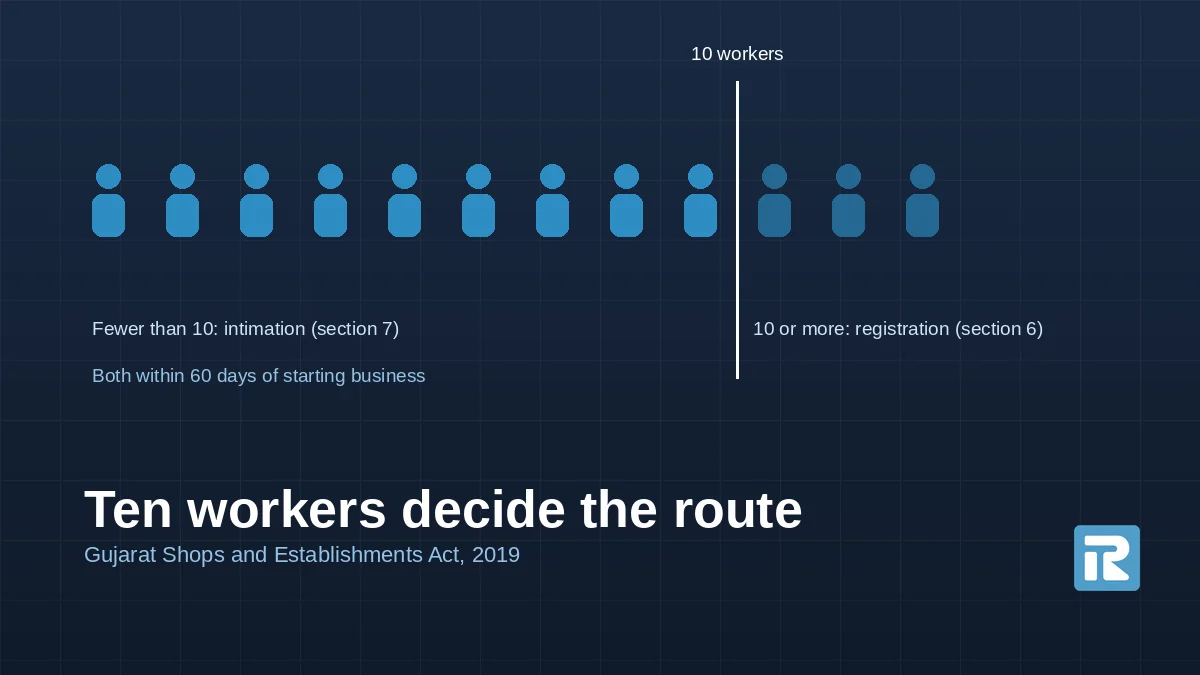
Under the Gujarat Shops and Establishments (Regulation of Employment and Conditions of Service) Act, 2019, an establishment with ten or more workers must apply for registration (section 6), and one with fewer than ten must give an intimation of commencing business (section 7). Either must be done within 60 days of the date the business starts.
- The Act extends to the whole of Gujarat.
- An establishment with fewer than ten workers that grows to ten or more must then obtain registration.
- An establishment with fewer than ten workers must inform the Inspector within 30 days of closing.
Many people in Gujarat still call this the gumasta licence, after the older Bombay Shops and Establishments Act. That Act was replaced in Gujarat by the 2019 Act, and the change matters: the new law sets the requirement by the number of workers, and most small establishments now give an intimation rather than taking out a licence.
Which businesses does the Gujarat Act cover?
The Act applies to shops and establishments across Gujarat. Most of its provisions apply to those employing ten or more workers. Section 7 applies to those employing fewer than ten, and requires an intimation instead of registration.
In practice this takes in retail shops, offices, showrooms, warehouses, restaurants, clinics, salons, coaching centres, studios and most other premises from which a business is carried on. Premises that are factories under factory law are generally covered by that law instead. If your activity sits at a boundary, for example a workshop that both repairs and sells, check the definitions in the Act or ask the local Inspector before deciding it does not apply.
Registration or intimation: which applies to you?
| Fewer than 10 workers | 10 or more workers | |
|---|---|---|
| What you file | Intimation of commencing business (section 7) | Application for registration (section 6) |
| Deadline | Within 60 days of starting business | Within 60 days of starting business |
| What you receive | A receipt of the intimation | A registration certificate |
| Fee | None stated for intimation in section 7 | A fee prescribed by the rules, shown on the portal |
| On closing | Inform the Inspector within 30 days | Follow the rules for surrender of registration |
Count workers as the Act defines them, at the establishment in question. The number can change, and the Act deals with that directly: if an establishment that gave an intimation reaches ten or more workers, all provisions of the Act apply to it and it must obtain registration under section 6.
What is the deadline, and who receives the application?
Sixty days from the date the shop or establishment commences its business, for both registration and intimation. The application or intimation goes to the Inspector appointed for the area, which is usually under the local authority.
For establishments in municipal areas the filing is made online. Gujarat's eNagar portal carries the shops and establishments service for urban local bodies, and the employer creates an account, completes the form for registration or intimation, uploads documents and pays any fee. Outside municipal areas the local authority, such as a nagarpalika or gram panchayat, is the point of contact. Because the arrangements differ by area, start with your local body's website or office and confirm which portal it uses.
What information and documents are usually asked for?
The Act requires the application or intimation to carry the details of the employer and the establishment, with self-declaration and self-certified documents. The exact list is set by the rules and the portal. The following is what is commonly requested:
Commonly requested
- Name, address and identity proof of the employer, with PAN
- Name and full address of the establishment
- Proof of the premises: an ownership document, or a rent or leave and licence agreement
- Nature of the business and date of commencement
- Number of workers, separately for men and women where asked
- For a firm, LLP or company: its registration or incorporation certificate, and the authorisation of the person applying
- Photograph of the employer or authorised person, and of the premises if requested
- 1
Count workers and choose the route
Fewer than ten: intimation. Ten or more: registration.
- 2
Find your area's portal or office
For urban areas, the eNagar service of your municipal corporation or nagarpalika. Elsewhere, the local authority's office.
- 3
Complete the form and upload documents
Enter the employer, establishment and worker details exactly as they appear on the documents you upload.
- 4
Pay any fee and submit
Registration attracts a prescribed fee. Keep the acknowledgement.
- 5
Keep the certificate or receipt at the premises
Inspectors, banks and landlords may ask for it.
What has to be done after registration?
A registration certificate remains in force until there is a change in the ownership or in the nature of the business. When either changes, the employer gives notice to the Inspector so a new certificate can be issued. For establishments with ten or more workers, to which the Act's other provisions apply, it also regulates working hours, overtime, leave, holidays and the employment of women at night, and requires records to be kept. Those obligations continue for as long as the establishment runs. An establishment with fewer than ten workers is subject to section 7, and to the full Act from the point it reaches ten.
How is this different from incorporation, GST and Udyam?
| Registration | What it is for | Who deals with it | When it applies |
|---|---|---|---|
| Company or LLP incorporation | Creates the legal entity | Ministry of Corporate Affairs | Only if you choose a company or LLP |
| Shops and Establishments | Records the premises and regulates employment there | Local Inspector under the Gujarat Act | For each shop or establishment, within 60 days of starting |
| GST | Tax registration for collecting and paying GST | GST portal | Above the turnover threshold, or from the first sale in certain cases |
| Udyam | Records the enterprise as micro, small or medium | Ministry of MSME portal | Optional, for access to MSME benefits |
None of these replaces another. A newly incorporated company that opens an office in Ahmedabad still files under the Shops and Establishments Act for that office. A proprietor with a GSTIN still files for the shop. Professional tax enrolment under Gujarat's professional tax law is separate again, and is often needed at around the same time. A restaurant, sweet shop or other food business also needs FSSAI registration or a food licence.
Common mistakes
- Assuming no employees means nothing to file. The intimation route exists precisely for small establishments.
- Filing for one location and not the others. Each establishment is filed for in its own area.
- Missing the move to registration when the workforce reaches ten.
- Not updating after a change of ownership, for example when a proprietorship becomes an LLP and the premises stay the same.
- Relying on an old gumasta licence issued under the earlier Act without checking what the 2019 Act requires now.
Sources
- Gujarat Shops and Establishments (Regulation of Employment and Conditions of Service) Act, 2019Extent to the whole of Gujarat; section 6 registration (ten or more workers) and section 7 intimation (fewer than ten), each within sixty days of commencing business; thirty-day closure intimation; move to registration on reaching ten workers.
- Section 7 of the Act, text as published by Indian KanoonWording of the sixty-day intimation and thirty-day closure periods, read on 23 October 2026.
- Labour and Employment Department, Government of GujaratAdministration of the Act and the Gujarat Shops and Establishments Rules, 2020, and rules under the labour codes.
- eNagar, Government of GujaratOnline shops and establishments service for urban local bodies.

Written by
Raulji Group
Raulji Group prepares and files business registrations and advises on the structure behind them. These guides are written by the people who handle the filings.
This article summarises the Gujarat Act as read on 23 October 2026. Forms, fees and portals are set by the rules and by each local authority and can change. It is not legal advice; confirm the requirement for your premises with the local Inspector or a qualified professional.