
What this article covers
- What each structure is in law, and what neither of them is
- Ownership, decision making, liability and continuity compared
- Why partnership registration is optional and why most firms do it anyway
- The documents each one needs, and the one document that matters most
The short answer
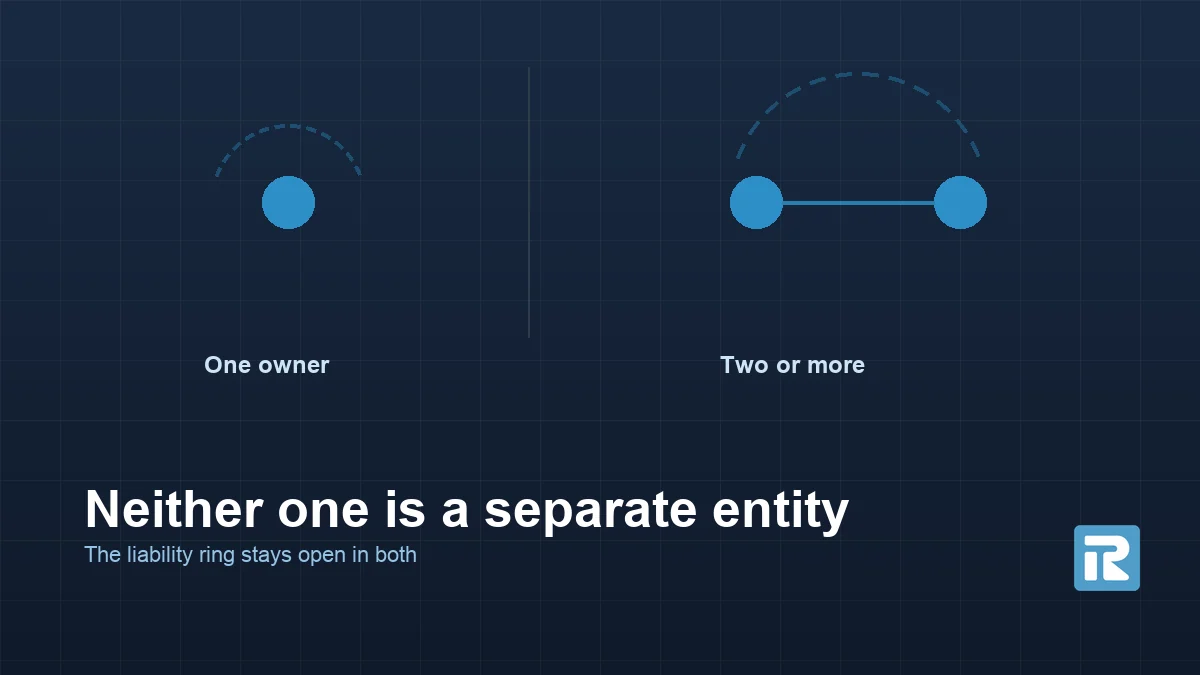
A proprietorship is one person trading in their own name in law. A partnership firm is two or more people trading under an agreement between them. Neither creates a separate legal entity, and in both the owners are personally liable for the business without limit.
- Proprietorship: one owner, complete control, no incorporation filing, and full personal liability. The business and the owner are the same person in law.
- Partnership Firm: two or more owners under the Indian Partnership Act, 1932, governed by a deed they write. Liability is unlimited and also joint and several, so any one partner can be pursued for the whole amount.
- If limited liability is what you are looking for, neither of these provides it. That is what an LLP or a company is for.
These two get compared because they are the two simple options, and because a lot of businesses start as one and become the other. Someone runs a shop or a workshop or a consultancy alone, the work grows, a second person comes in with money or skill, and the arrangement needs a name.
What is worth understanding before that happens is that moving from one to the other changes less than people expect on liability, and more than people expect on documentation. The second person does not make the business safer. They make it more complicated, and the deed is what keeps that complication manageable.
What is a proprietorship, and what is a partnership firm?
A proprietorship is a business owned and run by one individual, with no legal separation between the owner and the business. A partnership firm is a relationship between two or more people who have agreed to share the profits of a business carried on by all or any of them acting for all, as defined in the Indian Partnership Act, 1932.
The phrase in the Act that does the most work is acting for all. Each partner is an agent of the firm and of the other partners for the purposes of the business. What one partner commits the firm to in the ordinary course of business binds the others, whether or not they were consulted. That single point accounts for most of what goes wrong in partnerships and most of what a well drafted deed is trying to control.
The two compared, point by point
| Proprietorship | Partnership Firm | |
|---|---|---|
| Governing law | No dedicated incorporation law | Indian Partnership Act, 1932 |
| Number of owners | One | Two or more |
| Separate legal entity | No | No |
| Owner liability | Unlimited | Unlimited, and joint and several between partners |
| Who decides | The owner, alone | The partners, as set out in the deed |
| Founding document | None required | Partnership deed, usually on stamp paper |
| Registration | No central registration; activity-based registrations only | Optional, with the state Registrar of Firms |
| PAN | The owner's own PAN | A separate PAN in the firm's name |
| Continuity | Ends with the owner | Depends on what the deed says |
| Adding an owner | Not possible without changing structure | By admitting a partner under the deed |
| Typical setup time | Days, once the activity registrations are in hand | Days for the deed, longer if you register with the Registrar of Firms |
How does liability actually differ?
In a proprietorship, the owner is liable for everything the business owes. In a partnership firm, every partner is liable for everything the firm owes, and a creditor can recover the full amount from any one of them regardless of profit shares.
That second point is called joint and several liability and it is the single biggest difference in risk between the two. In a proprietorship your exposure is limited to your own decisions. In a partnership it includes your partner's decisions, taken in the ordinary course of the business, whether or not you agreed with them or knew about them.
Decision making and control
A proprietor decides alone, immediately, and answers to no one inside the business. That is the real advantage of the structure and it should not be dismissed. For a business that lives on quick decisions and a single person's judgement, adding a partner for the sake of appearing larger is a bad trade.
A partnership replaces that with whatever the deed says. Where the deed is silent, the Act supplies defaults, and the defaults are rarely what the partners would have chosen if asked. Equal profit sharing is one of them. Partners who contributed very different amounts of capital and time are frequently surprised to discover this after a disagreement rather than before.
What a partnership deed should settle before you sign it
- Capital contributed by each partner, and whether interest is payable on it
- How profits and losses are shared, in figures rather than in principle
- Who can commit the firm, and above what value a second signature is required
- Salaries or drawings, and how they are treated against profit share
- Duties and working hours expected of each partner
- How a new partner is admitted, and on what terms
- What happens when a partner wants to leave, dies or becomes unable to work
- How the firm is valued if someone exits, and how they are paid out
- How disputes are resolved, and where
Is registration required for a partnership firm?
No. Registration with the state Registrar of Firms is optional under the Indian Partnership Act, 1932. But an unregistered firm carries a serious disability under Section 69 of the Act, which is why most firms that deal on credit register.
Section 69 bars an unregistered firm from filing a suit to enforce a right arising from a contract against a third party. It also bars a partner from suing the firm or the other partners to enforce a right arising from the partnership contract. In plain terms: if a customer does not pay you, an unregistered firm cannot go to court to recover the money on the contract. Certain rights are preserved, including the right to sue for dissolution of the firm and for accounts of a dissolved firm, but the general bar is wide.
A proprietorship has no equivalent question, because there is no firm to register. A proprietor sues and is sued in their own name.
What documents does each one need?
Proprietorship
There is no incorporation filing, so what you register depends entirely on what you do. In practice a proprietor usually ends up with some combination of the following, and none of them is a registration of the business as such.
- The owner's PAN and Aadhaar, since the business is taxed as part of the owner's income
- Udyam registration, if the business qualifies as a micro, small or medium enterprise
- GST registration, where turnover crosses the applicable threshold or the activity otherwise requires it
- A shops and establishment registration, where the state and the premises require one
- Any licence specific to the activity, such as food, drugs or professional licensing
- A current account in the business name, for which the bank will ask for two of the registrations above
Partnership firm
- A partnership deed, typically executed on stamp paper of the value the state prescribes
- PAN and Aadhaar of every partner, and address proof for each
- A PAN application in the firm's name, since the firm is assessed separately from the partners
- Proof of the place of business, and a no-objection certificate from the owner where the premises are rented
- The application to the Registrar of Firms, where the partners choose to register
- The same activity-based registrations a proprietorship needs: GST, Udyam, licences, and so on
What happens to the business when someone leaves?
A proprietorship does not survive its owner. There is no entity to inherit. What passes on is assets, and the heirs who want to continue the business start a new one, with new registrations, a new GST number and new contracts.
A partnership firm survives a partner's exit only to the extent the deed provides for it. Where the deed is silent, the retirement, insolvency or death of a partner can dissolve the firm between the existing partners. A deed that says the firm continues between the remaining partners, and sets out how the outgoing partner's share is valued and paid, is the difference between a transition and a shutdown.
If continuity is genuinely important to you, that is a signal worth listening to. It is the strongest practical argument for looking at an LLP instead, since an LLP continues regardless of changes in partners and gives limited liability at the same time.
When is each one worth considering?
A proprietorship may suit you if
- You are the only owner and expect to stay that way for the foreseeable future
- The business is local, service-based or small in scale, and does not carry large credit exposure
- You want to start trading quickly with minimum cost and minimum administration
- You are testing an idea and want to see whether it works before committing to a structure
A partnership firm may suit you if
- Two or more people are genuinely running the business together and want a written arrangement
- The partners are comfortable with unlimited liability, including for each other's business commitments
- The business does not need to raise outside investment
- You want something more formal than an understanding, without the compliance a company carries
Neither may suit you if
- The activity could produce a liability larger than the owners can personally absorb
- The business needs to continue independently of the people who started it
- Outside investment is part of the plan
- Your customers require a company or an LLP on the other side of the contract
That last group is the one worth taking seriously. A great many businesses register as a partnership firm because it is the familiar option in their trade, and later discover that an LLP would have given them the same working arrangement with limited liability and genuine continuity. It is worth at least comparing before you sign a deed.
Frequently asked questions
What is the main difference between a proprietorship and a partnership firm?
The number of owners and the documentation that follows from it. A proprietorship has one owner and no founding document. A partnership firm has two or more owners under a deed that governs profit sharing, decision rights and exits. In both cases the owners are personally liable for the business without limit, and neither is a separate legal entity.
Is a partnership firm required to register with the Registrar of Firms?
No, registration is optional under the Indian Partnership Act, 1932. However, Section 69 bars an unregistered firm from suing a third party to enforce a contractual right, and bars a partner from suing the firm or co-partners on the partnership contract. Firms that sell on credit generally register for this reason.
Does a proprietorship need any registration at all?
There is no registration of the proprietorship itself. What you register depends on the activity: GST where the turnover threshold is crossed or the supply otherwise requires it, Udyam where the business qualifies as an MSME, a shops and establishment registration where the state requires one, and any licence specific to the trade.
Does a partnership firm have its own PAN?
Yes. A partnership firm is assessed separately for income tax and applies for a PAN in the firm's name. A proprietorship does not, because the business income is assessed as part of the proprietor's own income under their personal PAN.
What is joint and several liability in a partnership?
It means each partner can be held liable for the entire debt of the firm, not just their share of it. A creditor can recover the whole amount from one partner, who is then left to recover the balance from the others under the deed. Profit-sharing ratios do not limit a creditor's claim.
Can a proprietorship be converted into a partnership firm?
Yes. In practice it means executing a partnership deed, obtaining a PAN for the firm, and applying for fresh registrations where the existing ones were held in the proprietor's name, including GST. Bank accounts are opened in the firm's name rather than transferred.
Should I choose an LLP instead of a partnership firm?
It is worth comparing. An LLP gives the partners limited liability and continues to exist regardless of changes in partners, which a partnership firm does not do reliably. In exchange it carries MCA registration and two annual filings. Where the partners' main concern is personal exposure or continuity, the LLP usually answers it better.
Sources
Official sources for the regulatory statements in this article. Each one notes what it supports, so a claim can be checked against it.
- The Indian Partnership Act, 1932Definition of partnership, mutual agency between partners, and the effect of non-registration under Section 69.
- Udyam Registration, Ministry of Micro, Small and Medium EnterprisesMSME registration availability for proprietorships and partnership firms.
Disclaimer. This article is for general informational purposes only. Stamp duty, registration procedure and documentation requirements vary by state and change over time. Verify current requirements with the relevant authority or a qualified professional before making a decision.
Written by
Raulji Group
Raulji Group prepares and files business registrations and advises on the structure behind them. These guides are written by the people who handle the filings.