
What this article covers
- What the structure decision actually settles, and what it does not
- The four structures compared on liability, ownership, compliance and funding
- A decision framework you can work through in about ten minutes
- What it is realistically like to change structure later
The short answer
There is no structure that suits every business. The right one falls out of four questions: how much personal risk the activity carries, how many owners there are and whether that will change, how much annual compliance you are willing to carry, and whether you will need outside investment.
- Private Limited Company suits businesses that will take on outside shareholders or investment, and that need a separate legal entity with limited liability. It carries the heaviest annual compliance of the four.
- LLP suits professional firms and partner-run businesses that want limited liability without a company's compliance load. It cannot issue equity shares.
- Partnership Firm suits two or more people running a business together on agreed terms, accepting unlimited liability. Registration with the state Registrar of Firms is optional but has real consequences.
- Proprietorship suits a single owner testing an idea or running a small local business. It is the simplest and the cheapest, and the owner carries unlimited personal liability.
Most people arrive at this decision from the wrong end. They have been told that a Private Limited Company looks more serious, that an LLP is cheaper to run, or that a proprietorship is what you start with and upgrade from later. Each is true in some situations and wrong in others, and none is a reason on its own.
The structure you register decides who is legally on the hook when something goes wrong, who owns the business, what you have to file every year whether or not you make money, and whether an investor can put money in without rewriting the whole arrangement. Those four things are worth ten minutes of thought before a single form is filed, because changing structure afterwards is possible but rarely cheap.
What does choosing a business structure actually decide?
It decides four things: the extent of your personal liability for business debts, who legally owns the business and how that ownership can move, the annual filings and audits you are required to complete, and the routes available for raising money.
It is worth being clear about what the structure does not decide. It does not decide whether you need GST registration, which follows from your turnover and the nature of your supply. It does not decide whether you can open a current account, hire staff, or sign contracts. All four structures can do all of those. And with the exception of a few licensed activities, it does not decide what business you are allowed to be in.
The four structures, side by side
| Private Limited | LLP | Partnership Firm | Proprietorship | |
|---|---|---|---|---|
| Governing law | Companies Act, 2013 | LLP Act, 2008 | Indian Partnership Act, 1932 | No separate incorporation law |
| Separate legal entity | Yes | Yes | No | No |
| Owner liability | Limited to unpaid amount on shares | Limited to agreed contribution | Unlimited, and joint and several | Unlimited |
| Minimum owners | 2 shareholders and 2 directors | 2 designated partners | 2 partners | 1 |
| Registered where | Ministry of Corporate Affairs | Ministry of Corporate Affairs | State Registrar of Firms, and registration is optional | No central register |
| Statutory audit | Every year, from the first year | Only above the thresholds in the LLP Act | Not required by the Partnership Act | Not required by any registration law |
| Annual filings with MCA | AOC-4 and MGT-7 or MGT-7A | Form 11 and Form 8 | None | None |
| Can issue equity shares | Yes | No | No | No |
| Continues if an owner exits | Yes | Yes | Depends on the deed | No |
Read that as trade-offs rather than a scoreboard. Everything in the Private Limited column that looks like an advantage has a compliance cost attached, and everything in the Proprietorship column that looks simple has a liability cost attached.
Start with liability, not with tax
Ask what the worst realistic claim against your business looks like. If a bad year, a disputed contract or a defective batch could produce a liability larger than what you can comfortably pay from personal savings, the limited liability structures deserve serious weight.
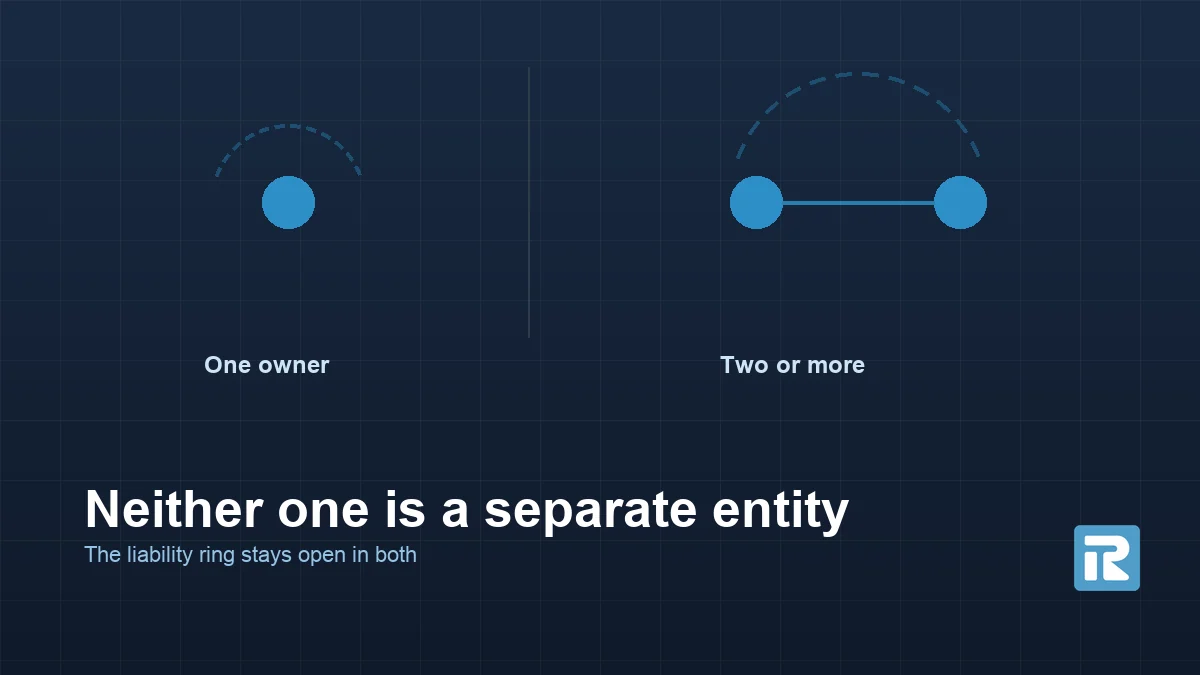
In a proprietorship and in a partnership firm, there is no legal line between the business and the people behind it. Business debts are their debts. In a partnership that goes further, because liability is joint and several: a creditor can pursue any one partner for the whole amount, regardless of profit shares, and that partner is then left to recover from the others.
A Private Limited Company and an LLP both draw that line. Shareholders are liable only for any amount remaining unpaid on their shares; LLP partners are liable to the extent of the contribution they agreed to. The line is not absolute in either case. Personal guarantees given to a bank sit outside it entirely, and that is how most small business lending in India is actually secured. Statutory dues, fraud and certain acts of the people running the business also attract personal consequences.
Who owns it, and will that change?
A single owner with no plan to bring anyone in has a short list: proprietorship, or a One Person Company if the separate entity matters. Two or more owners open up all four.
The question that separates them is what happens when the ownership needs to move. In a Private Limited Company, shares transfer without disturbing anything else. Contracts, licences, bank accounts and staff stay with the company, because the company is the party to all of them. In an LLP, partners can be admitted and retired under the LLP agreement, which is more involved than a share transfer but well defined. In a partnership firm, much of this depends on how carefully the deed was drafted, and in practice a partner leaving often means a new deed. In a proprietorship there is nothing to transfer, because the business and the owner are the same person in law.
What will you have to file every year?
A Private Limited Company carries an annual statutory audit from its first financial year regardless of turnover, plus annual filings with the Registrar of Companies. An LLP files an annual return and a statement of accounts and solvency, and only needs an audit once it crosses the thresholds in the LLP Act. Partnership firms and proprietorships have no MCA filing at all.
This is the cost people underestimate, because it recurs whether or not the business trades. A company that earned nothing still needs its accounts audited, its board meetings minuted and its annual forms filed. A dormant LLP still files Form 11 by 30 May and Form 8 by 30 October, with late fees per day and no ceiling.
None of this is an argument against a company. It is an argument for choosing one deliberately. If the business genuinely needs a corporate structure, the compliance is the price of it and it is a manageable price. If it does not, the same money is better spent elsewhere in the first two years.
Will you need outside money?
If you expect to raise equity from angel investors or a fund, a Private Limited Company is effectively the only one of the four that works, because it is the only one that can issue shares.
Priced rounds, convertible instruments and ESOP pools are all built on share capital. An LLP has contribution and profit shares instead, which can carry an investor in principle but are not what Indian investment documentation is written for. Partnership firms and proprietorships have neither.
Debt is a different matter, and worth separating out. Banks lend to all four structures. What they ask for is a track record, security and, in most cases, personal guarantees from the owners. The structure affects the paperwork more than the decision.
There is one more funding-adjacent point. Recognition as a startup by the Department for Promotion of Industry and Internal Trade, under the Startup India scheme, is available to a Private Limited Company, an LLP and a registered partnership firm. A proprietorship is not eligible. If the schemes attached to that recognition are part of the plan, the structure has to support it.
A framework you can work through now
- 1
Count the owners, and count them again for three years out
One owner with no plan to add anyone points to a proprietorship. Two or more, or one who expects a co-founder, rules it out.
- 2
Size the worst realistic liability
If the answer is larger than you would want to pay personally, weight the limited liability structures heavily. If the activity is low risk and low value, the unlimited liability structures stay on the table.
- 3
Decide whether equity investment is a real plan or a distant maybe
A real plan means a Private Limited Company. A distant maybe does not, because you can convert later and the conversion is a known process.
- 4
Price the annual compliance honestly
Add up audit, filings and professional fees for a full year and ask whether the business can carry it in year one. A structure you cannot maintain is worse than a simpler one you can.
- 5
Check whether anyone is going to insist
Large customers, tender processes and some lenders ask for a company on the other side of the contract. If that is your market, it settles the question early.
Before you decide, have these five answers ready
- The number of owners now and the number you expect in three years
- The largest single liability the business could realistically face
- Whether equity investment is planned, and roughly when
- What a full year of compliance will cost for each structure you are considering
- Whether your customers or lenders require a particular structure
Where this decision commonly goes wrong
- Registering a company for appearances. A Private Limited Company on a visiting card does not win work that the work itself would not have won. The compliance arrives regardless.
- Treating a proprietorship as a non-decision. It is a decision, and the thing it decides is that you are personally liable for everything the business owes.
- Choosing on registration cost alone. The difference between the four at setup is small next to the difference across three years of compliance.
- Assuming tax will settle it. It sometimes does, but only against real projected numbers. In the first two years the compliance difference is usually larger than the tax difference.
- Leaving the partnership deed or LLP agreement to a template. These are the documents that govern every disagreement you will ever have with your co-owners.
Can you change structure later?
Yes. The Companies Act and the LLP Act both provide for conversion, and in practice businesses move from proprietorship or partnership into an LLP or a company fairly regularly. It is a defined process, not a quick one, and it has costs.
Conversion means moving the business across: contracts may need assignment or novation, licences and registrations may need fresh applications, bank accounts are opened anew, GST registration changes, and the transfer of assets has tax consequences to look at case by case. It is manageable, just more work than getting it right at the start, which is why this decision is worth taking slowly even though the registration itself is quick.
The practical reading of that: do not over-engineer for a future that may not arrive, and do not pick something you will certainly outgrow within a year. Those are the two errors, and they sit on opposite sides of the same question.
Frequently asked questions
Which business structure is best in India?
None of them is best in general. A Private Limited Company suits businesses raising equity or needing a separate corporate entity. An LLP suits partner-run and professional firms that want limited liability with lighter compliance. A partnership firm suits owners who accept unlimited liability and want a simple arrangement. A proprietorship suits a single owner starting small. The right answer depends on liability, ownership, compliance capacity and funding plans.
What is the cheapest business structure to start in India?
A proprietorship is the cheapest, because there is no incorporation filing to make. You register only what your activity requires, such as GST or Udyam or a shops and establishment registration. The trade-off is that the owner is personally liable for all business obligations.
Do I need a minimum capital to register a Private Limited Company?
No. The Companies Act, 2013 does not prescribe a minimum paid-up capital for a private company. You still state an authorised and subscribed capital in the incorporation documents, and government fees are linked to it, so the figure is chosen rather than absent.
Is registration compulsory for a partnership firm?
Registration with the state Registrar of Firms is optional under the Indian Partnership Act, 1932, but an unregistered firm faces a significant restriction. Section 69 bars an unregistered firm from filing a suit to enforce a contractual right against a third party, and bars a partner from suing the firm or co-partners on the partnership contract. Most firms that deal on credit register for this reason.
Can a single person register a company in India?
Yes, as a One Person Company under the Companies Act, 2013. A Private Limited Company needs a minimum of two shareholders and two directors, though the same two people can hold both roles.
Does an LLP need an audit?
Only above the thresholds set under the LLP Act. An LLP is required to have its accounts audited where turnover exceeds Rs 40 lakh or where partner contribution exceeds Rs 25 lakh. Below both, it is exempt. A Private Limited Company, by contrast, is audited every year from its first financial year regardless of turnover.
Can I convert a proprietorship into a Private Limited Company later?
Yes, and it is a common path. The conversion process moves the business into the new entity, which means fresh registrations, new bank accounts, and a case by case look at contracts, licences and the tax treatment of assets transferred. It is a defined process rather than a simple renaming, so it is worth planning for rather than assuming.
Sources
Official sources for the regulatory statements in this article. Each one notes what it supports, so a claim can be checked against it.
- Ministry of Corporate AffairsCompanies Act and LLP Act incorporation requirements, annual filings and forms.
- Startup India, Department for Promotion of Industry and Internal TradeEntity types eligible for DPIIT startup recognition.
- Income-tax Act, 2025, in force from 1 April 2026Replacement of the Income-tax Act, 1961 and the move to the tax year concept.
Disclaimer. This article is for general informational purposes only. Requirements, procedures and fees change. Verify current requirements with the relevant authority or a qualified professional before making a decision.
Written by
Raulji Group
Raulji Group prepares and files business registrations and advises on the structure behind them. These guides are written by the people who handle the filings.