After Incorporation: A Compliance Checklist for New Companies
The certificate of incorporation starts several clocks at once. This checklist sorts what is due in the first 30 days, the first 180 days, what depends on your business, and what recurs every year, for companies and LLPs.

Raulji Group
Vadodara, Gujarat
Published
Updated
11 min read
The short answer: what must a new company do after incorporation?
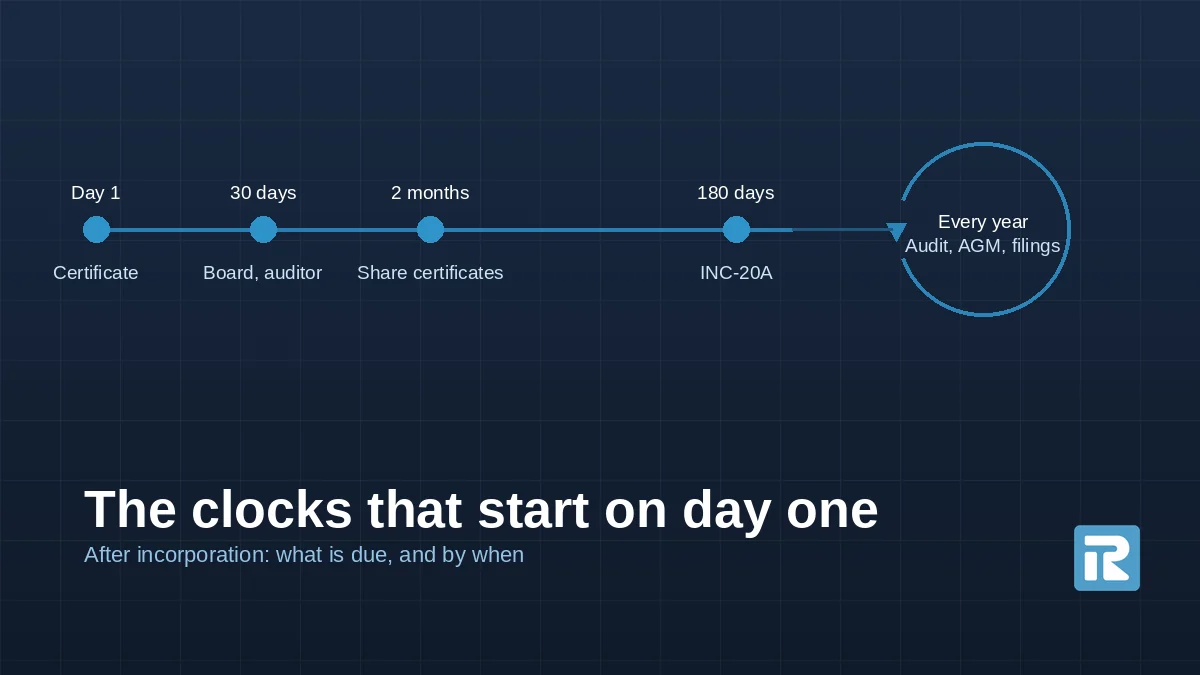
Within 30 days, hold the first board meeting and appoint the first auditor. Within two months, issue share certificates to the subscribers. Within 180 days, once every subscriber has paid for their shares, file Form INC-20A, the declaration for commencement of business. From then on the annual cycle runs: board meetings, an audit every year, an AGM, and the annual accounts and return filed with the Registrar.
- A company with share capital should not commence business or borrow until INC-20A is filed.
- Statutory audit applies from the first financial year, whatever the turnover.
- An LLP has a different and lighter set of obligations, starting with its LLP agreement in Form 3 within 30 days.
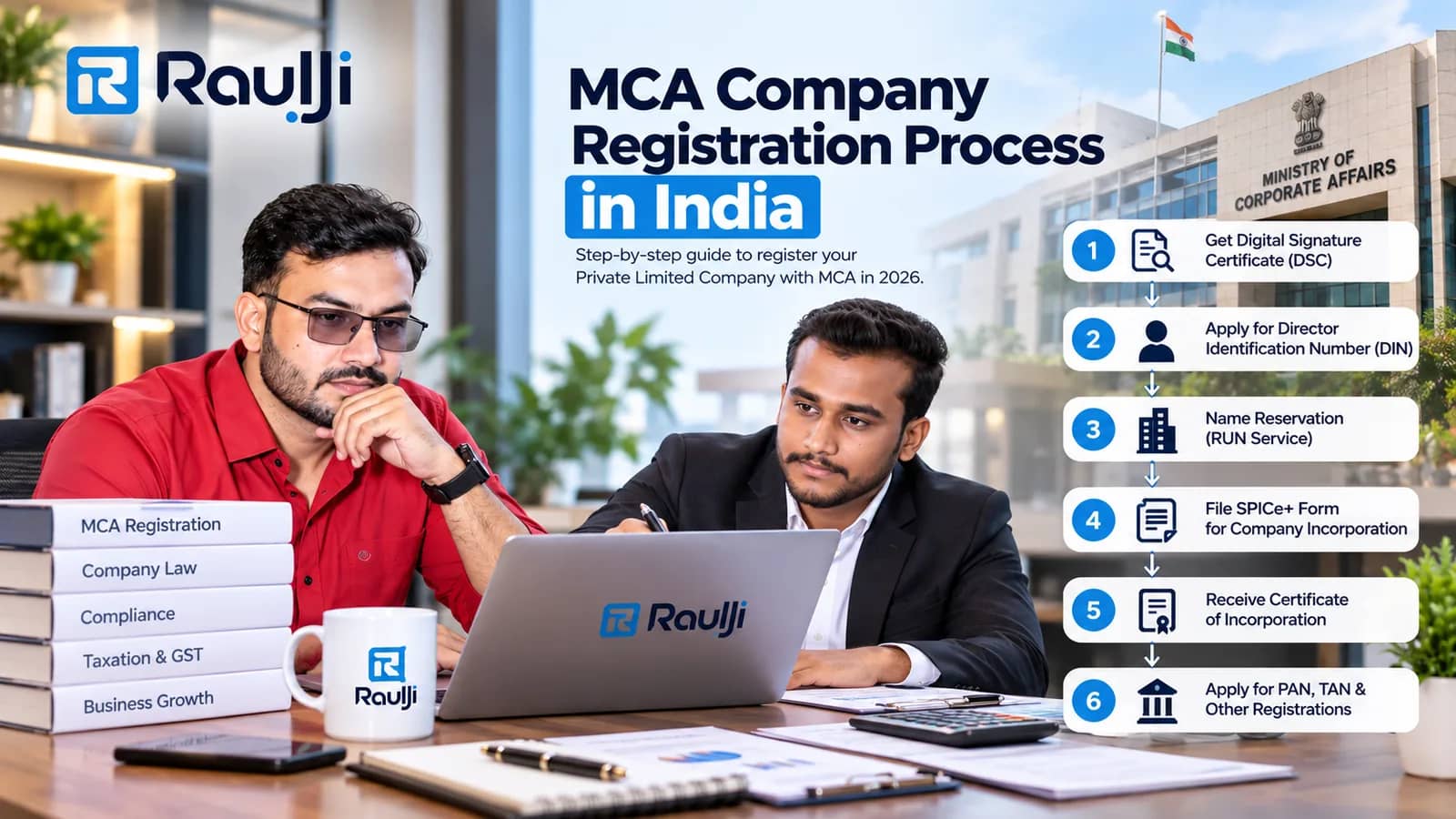
Incorporation is the point at which the company's obligations begin, not the point at which the work ends. Most of what follows has a fixed deadline counted from the date on the certificate of incorporation, and several of them fall in the first month, while founders are busy opening a bank account and starting to trade. This guide puts them in date order. For how the incorporation itself works, see the MCA registration process.
What is due, and by when?
| Deadline | Action | Where it comes from |
|---|---|---|
| Immediately | Open a current account in the company's name and receive each subscriber's share money into it | Needed for INC-20A |
| Within 30 days | Hold the first board meeting | Companies Act, 2013, section 173(1) |
| Within 30 days | Board appoints the first auditor (or members within 90 days if the board does not) | Section 139(6) |
| Within 2 months | Issue share certificates to the subscribers to the memorandum | Section 56(4)(a) |
| Within 180 days | File Form INC-20A, declaring that subscribers have paid for their shares | Section 10A |
| Each year | Board meetings, statutory audit, AGM, financial statements (AOC-4) and annual return (MGT-7 or MGT-7A) | Sections 173, 139, 96, 137 and 92 |
Which documents and records should you keep from day one?
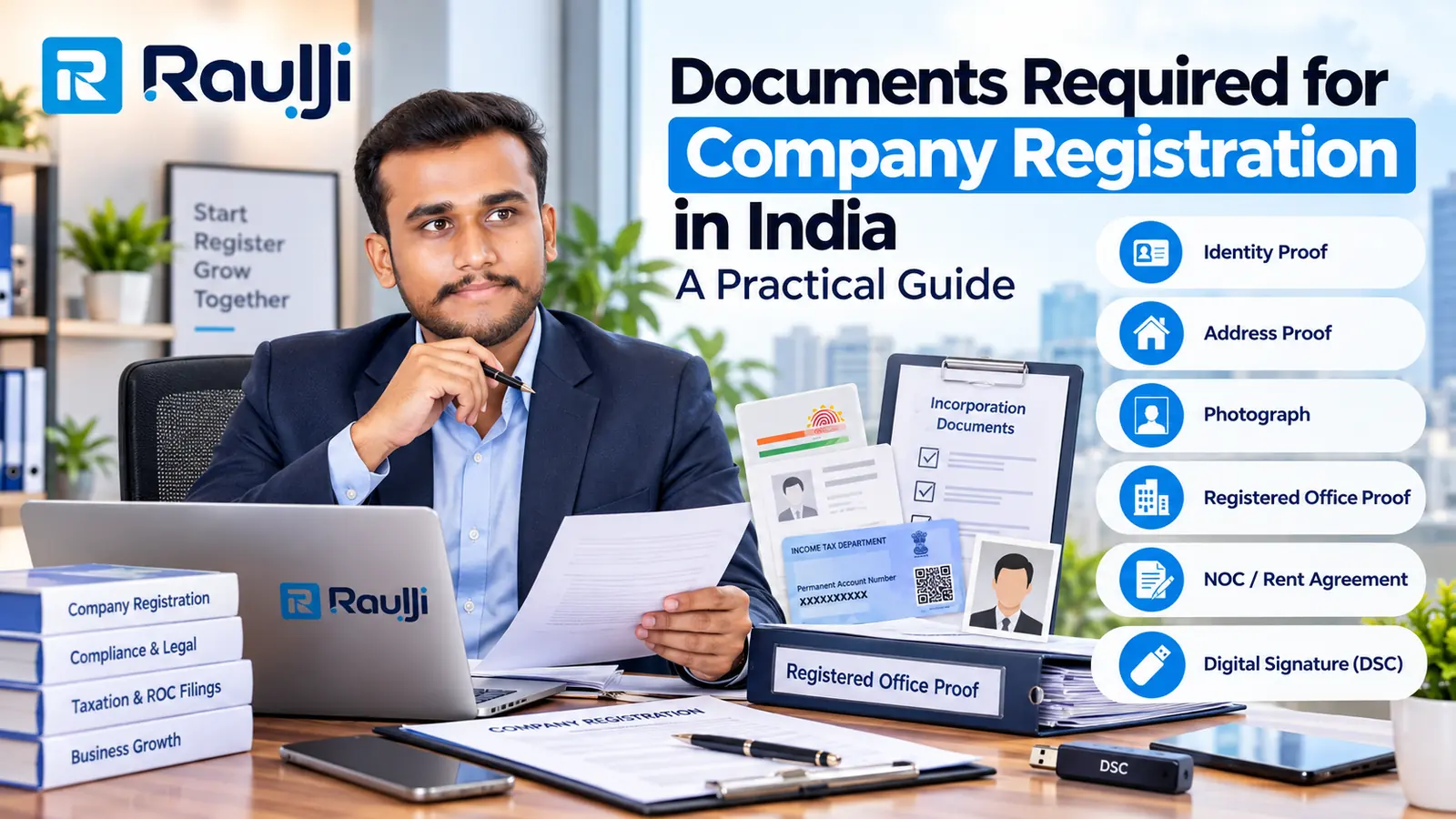
Keep the incorporation documents safe, set up the statutory registers and a minutes book, and keep books of account at the registered office. These are obligations from the start, not tidying up for later.
Keep these together
- Certificate of incorporation, with the CIN, PAN and TAN issued through SPICe+
- The memorandum and articles of association as filed
- Copies of the SPICe+ filing and its attachments
- Digital signature certificates of the directors, kept by the people they belong to
- Proof of the registered office and the owner's no-objection, if rented
- Register of members, register of directors and key managerial personnel, and other statutory registers as they apply
- Minutes book for board and general meetings
- Books of account, kept at the registered office, from the first transaction (section 128)
What are the registered office and commencement requirements?
A company must have a registered office capable of receiving communications (section 12). Its name and registered office address, along with its CIN, must appear on its business letters, invoices and website, and its name must be displayed outside every office where it carries on business.
Section 10A requires a company with share capital to file Form INC-20A within 180 days of incorporation, declaring that every subscriber has paid the value of the shares they agreed to take. Until it is filed, the company should not commence business or exercise borrowing powers. If it is not filed and the Registrar has reason to believe the company is not carrying on business, the company's name can be removed from the register. Filing it early, as soon as the share money is in the bank, removes the risk.
What happens at the first board meeting, and who appoints the auditor?
The first board meeting must be held within 30 days of incorporation. A typical agenda takes note of the certificate and the memorandum and articles, records directors' disclosures of interest, confirms the registered office, approves opening the bank account and the signatories, appoints the first auditor, and approves issuing share certificates.
Under section 139(6), the board appoints the first auditor within 30 days. If the board does not, it must tell the members, who appoint the auditor within 90 days at an extraordinary general meeting. The first auditor holds office until the end of the first annual general meeting.
What needs to happen with the share capital?
Each subscriber pays the amount for the shares they subscribed to in the memorandum, into the company's own bank account. The company issues share certificates within two months of incorporation and enters the members in the register of members. Stamp duty on the issue of shares may also be payable under state law. Keep the bank statement showing the receipts, because INC-20A relies on it.
What does the annual compliance cycle look like?
- Board meetings. At least four a year, with no more than 120 days between two meetings. A small company or a one person company needs at least one meeting in each half of the calendar year, at least 90 days apart (section 173).
- Statutory audit. Every financial year from the first, regardless of turnover.
- Annual general meeting. The first AGM within nine months of the end of the first financial year, and later AGMs within six months of each year end (section 96).
- Financial statements. Form AOC-4 within 30 days of the AGM (section 137).
- Annual return. Form MGT-7, or MGT-7A for a small company or one person company, within 60 days of the AGM (section 92).
- Director KYC. Each director files Form DIR-3 KYC once every three financial years, by 30 June, under the rules in force from 31 March 2026, and updates changed contact details within 30 days.
- Other returns where they apply, such as the return of deposits (DPT-3) and the half-yearly return of amounts owed to micro and small enterprise suppliers (MSME-1).
A company incorporated between 1 January and 31 March may end its first financial year on 31 March of the following year, under section 2(41), which makes the first year longer than twelve months. Confirm the first year end with your accountant before the first deadlines are calculated.
Which tax, payroll and local registrations depend on your business?
These are not automatic. Whether each applies depends on what the business does, where, and whom it employs.
- Income tax and TDS. PAN and TAN come with incorporation. A return is filed every year, including a year with no income. TDS obligations begin once the company pays salaries, rent or professional fees above the limits in the income-tax law.
- GST, if turnover crosses the threshold or the business makes supplies that require registration from the first sale. See GST registration in Gujarat.
- EPF and ESI, once the number of employees reaches the thresholds that apply, traditionally 20 for provident fund and 10 for ESI in covered areas. Both now operate under the Code on Social Security, 2020; confirm the current thresholds before relying on them.
- Professional tax, where the state levies it. Gujarat does.
- Shops and establishments, for each office or shop the company opens. In Gujarat, within 60 days of starting business there; see the Gujarat guide.
- Udyam, optional, if the company qualifies as an MSME and wants access to MSME benefits; see Udyam registration.
- Activity licences, such as FSSAI registration or a food licence for food, or an Import Export Code for foreign trade.
How are an LLP's obligations different?
| When | What |
|---|---|
| Within 30 days of incorporation | File the LLP agreement in Form 3 |
| By 30 May each year | Annual return in Form 11 |
| By 30 October each year | Statement of account and solvency in Form 8 |
| Each year, if applicable | Audit, where turnover exceeds ₹40 lakh or contribution exceeds ₹25 lakh |
| Once every three financial years | DIR-3 KYC for each designated partner holding a DIN |
An LLP has no board meetings, no AGM and no share certificates, which is a large part of why its compliance is lighter. The tax, payroll and local registrations above apply to it in the same way as to a company. For the choice between the two, see Private Limited Company vs LLP.
Which post-incorporation mistakes are most common?
- Leaving INC-20A until the 180 days are nearly up, often because share money was never actually deposited.
- Missing the first board meeting and auditor appointment in the first 30 days.
- Running company money through a director's personal account before the current account is open.
- Assuming no turnover means no filings. Audit, the AGM and the annual filings apply to a company that has not traded.
- Not keeping registers and minutes from the start, and reconstructing them later.
- Forgetting the state layer: shops and establishments and professional tax for the office.
- Letting a director's DIN be deactivated by missing a KYC filing, which then blocks the company's filings.
The checklist
Immediate (first 30 days)
- Open the company's current account and receive subscribers' share money
- Hold the first board meeting and record the minutes
- Appoint the first auditor, and file ADT-1
- Set up statutory registers, minutes book and books of account
- Display the company name at the registered office, and add the name, CIN and address to letterheads, invoices and the website
Within two to six months
- Issue share certificates within two months
- File INC-20A within 180 days, as soon as share money is received
Conditional, as the business requires
- GST registration
- Shops and establishments registration or intimation for each premises
- Professional tax
- EPF and ESI once employee numbers reach the thresholds
- TDS compliance once payments start
- Udyam and activity licences
Recurring
- Board meetings at the required frequency
- Statutory audit, AGM, AOC-4 and MGT-7 or MGT-7A
- Income-tax return every year
- DIR-3 KYC for each director once every three financial years, and updates within 30 days of any change
- DPT-3 and MSME-1 where they apply
Sources
- Ministry of Corporate Affairs: Companies Act, 2013 and rulesSections 2(41), 10A, 12, 56(4), 92, 96, 128, 137, 139(6) and 173; Forms INC-20A, AOC-4, MGT-7 and MGT-7A.
- MCA FAQs on SPICe+ and linked filingsPAN, TAN and other registrations issued through SPICe+ at incorporation.
- Companies (Appointment and Qualification of Directors) Amendment Rules, 2025, G.S.R. 943(E)DIR-3 KYC once every three financial years from 31 March 2026, due by 30 June.
- Limited Liability Partnership Act, 2008 and LLP Rules, 2009Form 3 within 30 days, Form 11 by 30 May, Form 8 by 30 October, and the LLP audit thresholds.

Written by
Raulji Group
Raulji Group prepares and files business registrations and advises on the structure behind them. These guides are written by the people who handle the filings.
This article reflects the Companies Act, 2013, the LLP Act, 2008 and the rules as checked on 23 October 2026. Deadlines and forms are amended from time to time, and some obligations depend on the company's size and activity. Confirm your company's position with a company secretary or chartered accountant.