Trademark Registration in India: Classes, Process and Common Mistakes
Registering a company name does not give you the right to stop others using it as a brand. A trade mark does. Here is how the process works, what it costs in government fees, and where applications go wrong.

Raulji Group
Vadodara, Gujarat
Published
11 min read
The short answer: how do you register a trademark in India?
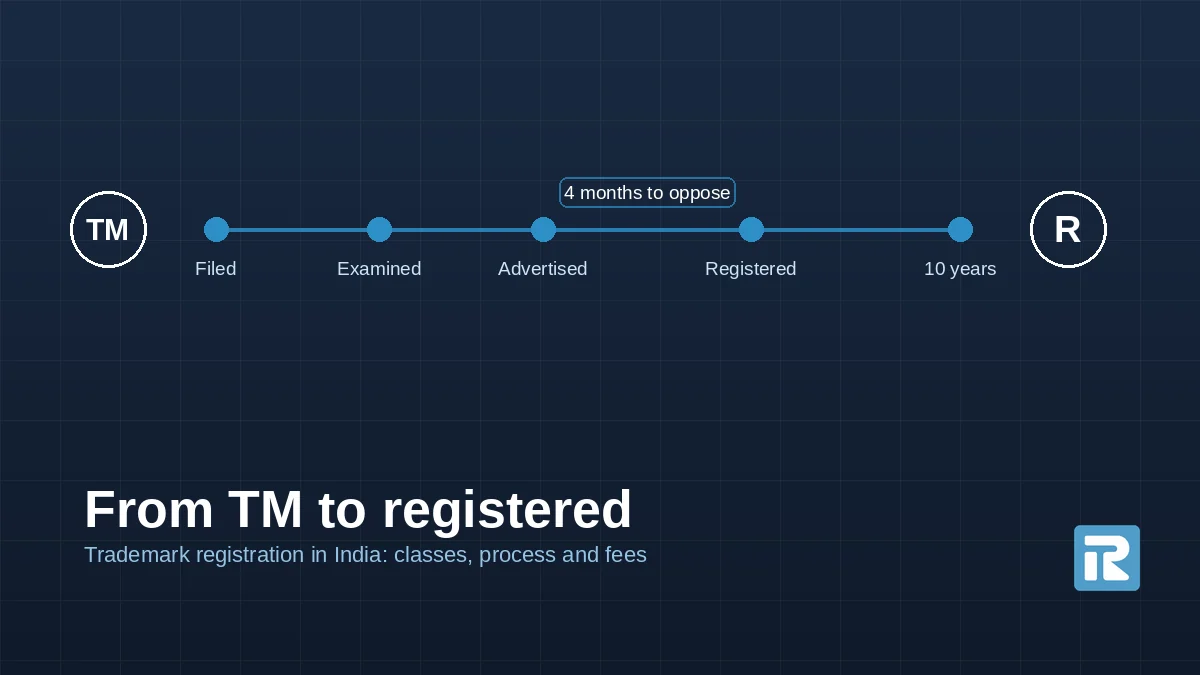
You apply to the Trade Marks Registry, part of the Office of the Controller General of Patents, Designs and Trade Marks (IP India), on Form TM-A, for each class of goods or services you use the mark for. The application is examined; if it is accepted it is advertised in the Trade Marks Journal, and anyone may oppose it within four months. If there is no successful opposition, the mark is registered for ten years and can be renewed indefinitely.
- The official e-filing fee is ₹4,500 per class for an individual, startup or small enterprise, and ₹9,000 per class for anyone else.
- Registration is not automatic and no one can guarantee it, or how long it will take.
- Use the ® symbol only once the mark is registered. Before that, ™ is commonly used to signal a claim.
Founders often assume that once a company or firm is registered under a name, the name is theirs. It is not, in the sense that matters for a brand. Company registration stops another company registering an identical name; it does not stop a business of any kind from trading under that name as a brand. That right comes from a trade mark, under the Trade Marks Act, 1999.
What does a trade mark protect?
A trade mark is a sign that identifies the goods or services of one business as distinct from others: a word, a name, a logo, a combination of these, and in some cases a shape, colour combination or sound. Registration gives the owner the exclusive right to use it for the goods or services it is registered for, and the right to sue for infringement.
| What it covers | Where it comes from | |
|---|---|---|
| Company or LLP name | The legal entity's name on the register | Ministry of Corporate Affairs, on incorporation |
| Trade mark | A brand used on goods or services, in specified classes | Trade Marks Registry, on registration |
| Copyright | Original creative work, such as logo artwork, text or software | Arises on creation; can be registered with the Copyright Office |
| Domain name | An internet address | A domain registrar, by contract; it is not an intellectual property right |
Why search before applying?
An application can be refused, or opposed, because a similar mark already exists for similar goods or services. Searching first tells you whether the mark you want is realistic before you spend fees, print packaging or build a brand around it. IP India provides a public trade mark search through its online services. Search for the exact mark, for spelling and phonetic variants, and in each class you intend to file in.
Raulji Group runs this kind of screen on a proposed business name when registering a company, LLP, firm or proprietorship, because a name that conflicts with a registered trade mark can cause trouble even after the entity is registered.
How do trade mark classes work?
Goods and services are divided into 45 classes under the international Nice Classification: classes 1 to 34 for goods and 35 to 45 for services. A mark is registered only for the classes, and the goods or services within them, that the application names.
Fees are charged per class. A bakery selling packaged biscuits and running a café would usually look at class 30 for the biscuits and class 43 for the café service. A software company might look at class 9 for downloadable software and class 42 for software services. These are examples of how the classes divide, not a recommendation for any business; describe your actual goods and services and check the classification before filing.
Who should be the applicant?
The applicant is the owner of the mark, so choose deliberately. A proprietor can apply in their own name. A partnership firm, LLP or company applies in its own name. The fee depends on the applicant: the lower fee applies to an individual, a startup recognised as such, and a small enterprise, which generally means providing supporting proof such as Udyam registration or startup recognition when asked.
If the mark belongs to the company but is filed in a director's personal name, the company does not own its own brand. Fixing that later requires an assignment.
What information does the application need?
Commonly needed for Form TM-A
- Applicant's name, address and legal status (individual, firm, LLP, company)
- The mark: the word, or a clear image of the logo
- The class or classes, and a description of the goods or services
- Whether the mark is already in use and from what date, or is proposed to be used
- Evidence of use from that date, if you claim prior use
- Proof supporting the lower fee category, where claimed
- A power of attorney (Form TM-48), if an agent files for you
How does the application process work?
- 1
File Form TM-A
File online through IP India's e-filing service and pay the fee for each class. The application receives a number and its filing date, which matters later.
- 2
Examination
An examiner checks the application against the Act: whether the mark is distinctive, whether it is merely descriptive, and whether it conflicts with earlier marks. The result is an examination report.
- 3
Reply to any objection
If the report raises objections, the applicant has one month from receiving it to file a reply. A hearing may follow. An unanswered objection can lead to the application being treated as abandoned.
- 4
Advertisement
An accepted application is published in the Trade Marks Journal, so the public can see it.
- 5
Opposition window
Under section 21 anyone may oppose within four months of advertisement. If opposed, the applicant files a counter-statement within two months, and the matter proceeds with evidence and a hearing.
- 6
Registration
With no opposition, or once an opposition is decided in the applicant's favour, the mark is registered and a certificate issued.
What are the official fees?
| Form and purpose | Individual, startup or small enterprise | All other applicants |
|---|---|---|
| TM-A: application for registration | ₹4,500 | ₹9,000 |
| TM-O: notice of opposition or counter-statement | ₹2,700 | ₹2,700 |
| TM-R: renewal of registration | ₹9,000 | ₹9,000 |
| TM-R with surcharge: late renewal | ₹4,500 plus the renewal fee | ₹4,500 plus the renewal fee |
These are government fees. Physical filing costs more. Anything a firm or agent charges on top is a professional fee for their work, such as searching, drafting the specification or replying to objections, and should be quoted separately so you can see the difference.
What happens after registration?
- Term. Registration lasts ten years and can be renewed for further ten-year periods, indefinitely, under section 25. Renew on Form TM-R before expiry; a late renewal carries a surcharge.
- The ® symbol. Use ® only for a registered mark. Representing an unregistered mark as registered is an offence under the Act. Before registration, ™ is commonly used to signal that you claim the mark.
- Use it. A registered mark that is not used for a continuous period can be vulnerable to removal for non-use.
- Watch for conflicts. Registration does not police itself. Owners watch the Journal and the market, and act against infringement.
- Record changes. If the owner's name or address changes, or the mark is assigned to another owner, the register should be updated.
Which mistakes cost applicants their mark?
- Choosing a descriptive name. A mark that describes the product, such as a quality or a place, is hard to register. An invented or arbitrary word is easier to protect.
- Skipping the search, then building a brand on a mark someone else registered first.
- Filing in the wrong name, such as a director's instead of the company's.
- Missing a deadline to reply to an examination report or an opposition.
- Claiming a use date you cannot prove.
- Believing promises. No one can guarantee registration or a timeline. Offers of instant or guaranteed trademarks describe filing, not registration.
Sources
- IP India: Trade Marks, forms and official feesFees for Forms TM-A, TM-O and TM-R, e-filing and physical, as read on 23 October 2026.
- Office of the Controller General of Patents, Designs and Trade MarksFiling, examination, advertisement in the Trade Marks Journal and the public search facility.
- WIPO: Nice ClassificationThe 45 classes of goods and services.
- Trade Marks Act, 1999, section 21, as published by Indian KanoonFour months to oppose after advertisement, and two months for the counter-statement.

Written by
Raulji Group
Raulji Group prepares and files business registrations and advises on the structure behind them. These guides are written by the people who handle the filings.
This article explains the trade mark process and IP India's official fees as checked on 23 October 2026. It is not legal advice. Raulji Group does not file trade mark applications; for an application, objection or opposition, consult a registered trademark agent or an advocate.